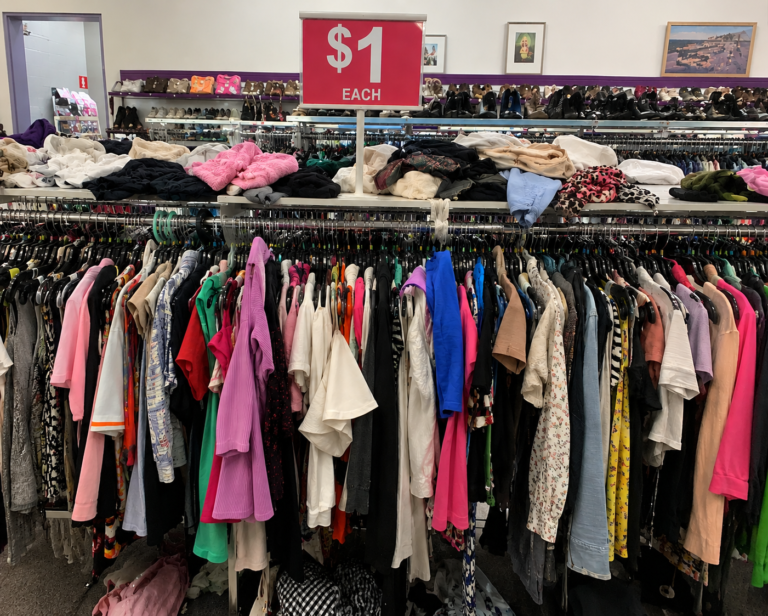
I’d have more money than most op shops make from their entire $1 rack in a week.
And that’s not a joke… it’s actually true when you look at the numbers.
After moderating Australia and New Zealand’s largest op shopping communities for years (180,000+ members combined across both countries), I see variations of this complaint several times every single day:
“That top is $4 but I can buy it new from Kmart for $3!”
“Why is this Shein dress $5 when I can get it online for $4?”
“This Temu item is more expensive here than buying it new!”
So let’s have a real conversation about what’s actually happening behind the scenes at op shops—and why this complaint misses the point entirely.
The Fast Fashion Tsunami
Here’s the uncomfortable truth that nobody wants to talk about:
Op shops across Australia and New Zealand are drowning in fast fashion donations.
Not a trickle. Not a steady stream. A tsunami.
Every single day, op shops receive:
- Garbage bags full of online fast fashion that didn’t fit
- Boxes of ultra-cheap items that fell apart after one wash
- Clothing so worn the fabric is see-through
- Online returns that never got sent back
- Pieces with tags still attached that were never worn
- Basics that pilled after two wears
And here’s the part that’ll surprise you: Most of it can’t be sold at any price.
Not $5. Not $2. Not even $1.
It’s not sellable because it’s:
- Stained beyond repair
- Stretched out or misshapen
- Pilled and fuzzy
- Faded or discolored
- Missing buttons or broken zippers
- So thin it’s transparent
- Falling apart at the seams
- Just genuinely poor quality to begin with
What You See vs. What Actually Happens
When you walk into an op shop and see that $4 Kmart top on the rack, here’s what you’re seeing:
One item. One price tag. One decision to make.
Here’s what you’re NOT seeing—the journey that item took to get onto that rack:
Step 1: The Donation Flood
The op shop received piles of fast fashion items that week. Could be in one donation, could be spread across multiple donors. But trust me, it’s a lot.
Step 2: The Sorting Reality
Volunteers (who are giving their time for FREE, remember) had to:
- Open every bag and box
- Pull out every single item
- Inspect each one for damage, stains, wear, quality
- Make decisions: Sell? Bin? Rag pile? (Except most can’t even be rags—more on that later)
- Sort the “maybe sellable” pile from the “definitely not” pile
Time spent: 2-3 hours minimum for 50+ items
Step 3: The Harsh Reality Check
Out of those fast fashion items:
- some pieces can’t be sold (stained, damaged, too worn)
- some pieces are borderline (might sell at $1-2, might not)
- some pieces are actually in decent condition
So that ONE $4 top you’re looking at? It’s one of the lucky items that survived the culling.
Step 4: The Disposal Cost
Those unusable pieces don’t just disappear.
The op shop has to:
- Bag them up
- Store them temporarily
- Transport them to the tip or pay a waste management service to do that
- Pay disposal fees
And depending on the local council and tip location, disposal costs are significant. We’re talking real money that comes directly out of the charity’s budget.
Step 5: Processing the “Good” Ones
For the items that made the cut:
- Check pockets
- Steam or press if needed
- Find hangers (which cost money)
- Add price tags
- Hang on racks (which take up floor space that costs rent)
- Display in the shop
More volunteer time: 1-2 hours
Step 6: The Floor Space Economics
That rack of fast fashion? It’s taking up valuable floor space.
Space that costs:
- Rent (commercial rent is expensive)
- Utilities (power, lighting, heating/cooling)
- Insurance
- Maintenance
Every square meter of floor space has a cost attached to it.
The $1-2 Rack: Everyone’s Favourite Money Loser
Let’s talk about that beloved $1-2 rack that everyone thinks is such a goldmine for op shops.
Here’s the actual math:
An 80-piece $1-2 rack generates:
- If priced at $1 each: $80 revenue
- If priced at $2 each: $160 revenue
- Let’s be generous and say mixed pricing averages $1.50: $120 revenue
To create that 80-piece rack, the shop had to:
- Sort through hundreds of donated fast fashion items (volunteer time)
- Dispose of unusable pieces (cost: real money for tip fees)
- Process the sellable pieces (volunteer time)
- Purchase hangers for 80 items (hangers have a cost)
- Use floor space for the rack (ongoing lease cost)
- Staff the register for 80 small transactions (volunteer time)
Conservative cost estimate:
- Disposal fees: Variable but significant
- Floor space lease
- Volunteer time: (priceless, but finite)
Even if we ignore volunteer time (which we shouldn’t, but let’s), the rack is barely breaking even—or actually losing money when you factor in disposal costs properly.
Now Compare: The $8-10 Quality Rack
Let’s look at the same 80 pieces of floor space filled with quality secondhand items priced at $8-10 each.
Revenue: $640-800
To create this rack, the shop:
- Sorted through donations (same volunteer time, but higher success rate because better quality donations)
- Disposed of fewer unusable items (quality donations last longer)
- Processed 80 items (same as before)
- Used same floor space
The difference?
$640-800 revenue vs. $120 revenue
Same volunteer time. Same floor space. 5-6x more money for the charity.
Which would you choose if you were trying to fund hospice care? Or animal welfare? Or community services?
The Polyester Problem Nobody Talks About
Here’s something most people don’t know:
That mountain of unusable fast fashion? Even if op shops wanted to repurpose it, most of it is useless.
“Why not use it as rags?”
Because the vast majority of fast fashion is made from polyester—which is a form of plastic.
Polyester doesn’t absorb water. It doesn’t work as cleaning rags. It doesn’t work as drop sheets. It’s not useful for much of anything once it’s worn out.
“Can’t it be recycled?”
Technically yes, but:
- It requires specialized industrial recycling facilities
- The process is expensive and not widely available
- It’s not infinitely recyclable like glass or aluminum
- Most op shops don’t have access to these facilities
So that worn-out Shein top? It’s just expensive rubbish that the op shop has to pay to dispose of.
“Just Put It in a Free Bin Outside!”
This suggestion comes up constantly in our community discussions. And I get the impulse—if it’s not sellable, why not give it away free instead of binning it?
Here’s why op shops don’t (and shouldn’t) do this:
Reason 1: They’re Charities, Not Waste Management
Op shops exist to raise funds for their charitable mission. They are not:
- Free clothing distribution centers
- Community recycling services
- Waste management solutions
They’re charities trying to fund hospice care, help vulnerable communities, support animal welfare, or provide essential services.
Reason 2: Free Bins Create More Problems
A “free bin” outside sounds simple, but it creates:
Logistical nightmares:
- Who sorts through new donations vs. free items?
- Where do you put it? (Takes up more space)
- Who maintains it?
- What happens when it overflows?
- Who deals with the mess when weather hits?
Liability issues:
- What if someone takes something damaged and gets hurt?
- What about hygiene concerns?
- Who’s responsible for the area?
Abuse potential:
- People dumping their rubbish “donations” there instead
- The bin becoming a dumping ground
Zero revenue:
- All this extra work, space, and hassle
- For exactly $0 fundraising
If an item isn’t worth $1 to someone, it’s probably not worth the shop’s time and resources to manage a free distribution system for it.
Reason 3: Volunteer Time Is Precious
Volunteers don’t come to op shops to manage free clothing bins and sort through more unusable donations.
They come to:
- Raise money for causes they care about
- Connect with their community
- Make a tangible difference
- Feel like their time matters
Asking them to spend hours managing free bins of unwanted fast fashion? That’s not what they signed up for.
The Volunteer Perspective
Let’s be really clear about something:
Volunteers are donating their time—which is valuable—to help a charity raise funds.
When you complain that a used Kmart top costs $1 more than buying it new, here’s what volunteers hear:
“Your time sorting through mountains of donations means nothing.”
“The charity’s disposal costs don’t matter.”
“The floor space and overhead costs are irrelevant.”
“I should get everything for next to nothing because it was donated.”
That’s not fair. And it’s not okay.
Volunteers deal with:
- Sorting through genuinely disgusting donations (yes, people donate soiled items)
- Lifting heavy boxes and furniture
- Dealing with complaints about pricing they didn’t set
- Explaining why items are priced the way they are
- Managing difficult customers
- Spending hours on their feet
- Doing unglamorous work that nobody sees
All so the charity can raise funds for its mission.
They deserve respect, not complaints about $1 price differences.
What This Means for Different Groups
For Shoppers:
If you’re comparing op shop prices to new fast fashion retailers, you’re completely missing the point of op shopping.
Op shops are not:
- Budget versions of Kmart/Shein/Temu
- Competing with online fast fashion on price
- Trying to undercut retail stores
- Obligated to sell everything for $1
Op shops ARE:
- Charities raising funds for important causes
- Sources of quality secondhand items that last
- Places to find vintage and unique pieces
- Alternatives to buying new
- Community spaces with social value
If your primary concern is saving $1-2 compared to buying new fast fashion, op shopping probably isn’t for you. And that’s completely okay! Shop where it makes sense for your priorities and budget.
But please don’t expect charities to lose money processing your donations so you can save $1 on a top.
For Donors:
Please stop “donating” unusable fast fashion.
Before you donate, ask yourself:
- Would I give this to a friend?
- Is it stained, damaged, or excessively worn?
- Is it quality enough to last for the next person?
- Would I actually want to receive this as a gift?
If the answer is no, bin it yourself. Don’t make the charity pay to dispose of your rubbish.
Better donation practices:
- Quality over quantity (one good piece beats ten worn-out ones)
- Check condition honestly
- Wash items before donating
- Button/zip things up
- Don’t donate items just because you’re too lazy to bin them
And if you’re regularly buying fast fashion online that doesn’t fit? Maybe stop doing that instead of making it the op shop’s problem.
For Op Shop Managers and Volunteers:
You don’t owe anyone an explanation for your pricing.
You’re making impossible decisions every day:
- Balance affordability with fundraising needs
- Manage donor expectations vs. reality
- Deal with disposal costs eating into revenue
- Navigate customer complaints
- Keep volunteers motivated
- Try to help your community while running a sustainable operation
Some suggestions based on what’s working for shops we see:
Be selective about donations:
- It’s okay to refuse items
- It’s okay to have quality standards
- It’s okay to turn away fast fashion
- You’re not obligated to accept everything
Communicate your costs:
- Share disposal fees with your community
- Explain floor space economics
- Help people understand volunteer time value
- Be transparent about what happens to unusable donations
Rethink the $1 rack:
- If it’s losing you money, eliminate it
- Or make it much smaller and very selective
- Or have rotating discount days instead
- Don’t feel guilty about prioritizing fundraising
Set boundaries:
- Train volunteers to handle pricing complaints calmly
- Have a standard response ready
- Don’t let customers bully you into discounts
- Remember your mission
The Bigger Picture: Fast Fashion Is Killing Op Shops
Here’s the uncomfortable truth that needs to be said:
The fast fashion business model is fundamentally incompatible with the op shop model.
Fast fashion is designed to:
- Be cheap to buy
- Fall apart quickly
- Get replaced frequently
- End up in landfill (or op shops)
Op shops need:
- Quality items that last
- Things people actually want to buy secondhand
- Donations that cover their processing costs
- Items that justify floor space and volunteer time
These two things cannot coexist sustainably.
Op shops are being used as free disposal services for the fast fashion industry’s waste problem. And they’re paying for the privilege with disposal fees, volunteer time, and floor space.
Something has to change.
Some op shops are already:
- Refusing fast fashion brands entirely
- Implementing strict quality standards
- Eliminating $1 racks
- Focusing only on quality secondhand
- Partnering with textile recycling companies (where available)
- Being more selective about what they accept
And honestly? More should follow.
Because volunteers didn’t sign up to manage the waste stream from Shein and Temu. They signed up to help fund hospice care, animal shelters, community services, and other important causes.
What Can Actually Be Done?
This isn’t a problem with easy solutions, but here are some thoughts:
Individual Actions:
As shoppers:
- Understand what op shops actually are (charities, not discount retailers)
- Appreciate the volunteer time that goes into everything
- Stop complaining about $1-2 price differences
- Focus on quality items, not fast fashion bargains
- Support shops however they choose to operate
As donors:
- Buy less fast fashion in the first place
- Bin your own worn-out items
- Only donate things you’d give to a friend
- Consider if op shops can actually sell what you’re donating
- Find textile recycling options in your area for unusable items
As community members:
- Defend volunteers when people complain about pricing
- Share the reality of op shop economics
- Support shops’ decisions about what to accept
- Understand that changes may be coming
Systemic Changes Needed:
Op shops need to:
- Set and communicate clear quality standards
- Be willing to refuse unsuitable donations
- Charge realistic prices that cover costs
- Educate their communities about their economics
- Consider alternative business models if needed
Councils and governments need to:
- Provide affordable textile recycling options
- Reduce or waive disposal fees for charities
- Support op shops as they deal with this crisis
- Recognize the environmental service op shops provide
Fast fashion companies need to:
- Well, let’s be honest, they’re not going to change voluntarily
- But at minimum, they should fund textile recycling infrastructure
- Take responsibility for their products’ end-of-life
- Stop designing things to fall apart
The Bottom Line
If I actually had a dollar for every “but it’s cheaper at Kmart!” complaint, I genuinely would have more money than most op shops make from their $1 racks.
And that tells you everything you need to know about the economics of that rack.
Op shops are facing an unprecedented crisis with fast fashion donations. They’re being forced to choose between:
- Losing money on $1 racks to meet community expectations
- Refusing donations and facing backlash
- Raising prices and dealing with complaints
- Closing down because they can’t afford disposal costs
None of these are good options.
So before you complain about a $4 Kmart top at an op shop, consider:
- The volunteer time that went into getting it there
- The disposal costs for the 40 similar items that couldn’t be sold
- The floor space that could be generating more revenue
- The charity mission that needs funding
- The fact that nobody owes you fashion for less than retail
Op shops are charities, not your personal discount warehouse.
They’re doing their best in an impossible situation.
Please give them grace.
Looking for quality secondhand across Australia and New Zealand?
Visit opshops.co to search our directory of op shops, vintage stores, secondhand shops, and markets across both countries.
Find shops that match your values, read reviews from real shoppers, and discover your next treasure—without expecting charities to lose money in the process.
What do you think? Share your perspective in the comments below.
Have you volunteered at an op shop? Seen this problem firsthand? Have a different take? Let’s hear it—respectfully, of course.

Leave a Reply
You must be logged in to post a comment.